



Understanding DVC Resale for Surviving Spouses

If you're a surviving spouse who needs to sell a Disney Vacation Club contract, the process is often simpler than you might expect. At DVC Sales, we've helped hundreds of families through this sensitive time, and we understand that dealing with a DVC membership may be one of many financial decisions you're navigating right now.
The good news is that in most cases, selling your DVC contract as a surviving spouse follows the same straightforward process as any other resale. You won't need to wait months or deal with complex legal requirements.
How to List Your DVC Contract as a Surviving Spouse
Getting your Disney Vacation Club membership listed for sale is straightforward in most situations. Here's what you'll need to do:
- Upload your most recent point statement and a copy of the deed
- Your listing can go live on DVC Sales right away, just like any standard DVC resale contract
This process allows potential buyers to view your listing immediately, and you maintain complete control over pricing and offers. You can accept, counter, or decline any offers that come in. For additional guidance on the overall process, you can review our DVC selling checklist for a detailed step-by-step overview.
What Documents Will You Need?
In the majority of DVC joint tenancy situations common among married couples, the title company will only require a copy of the death certificate. This legal structure, known as joint tenancy with rights of survivorship, automatically grants the surviving spouse the authority to sell the DVC membership without additional court proceedings or legal steps.
If the deed is held differently, such as tenants in common or with other family members as owners, the title company might request additional documentation, such as:
- Probate paperwork
- A small estate affidavit
- Signatures from heirs or other owners
While these situations are less common, the process remains manageable. The title company and our DVC Sales team will clarify every requirement and provide clear guidance throughout the closing process.
Streamlining the Process
To help streamline your experience, visit the General Questions section of your DVC Sales profile and indicate your status as a widow or widower. You can upload the death certificate directly there, allowing our team to prepare your file and coordinate efficiently with the title company before any offers come in.
If you're unsure how your DVC deed is titled, we can review it for you in advance. We'll answer any questions and make sure your DVC resale contract is set up for a smooth closing. This saves time later when you're ready to accept an offer.
Understanding Your DVC Contract Value
When you're ready to sell, understanding your contract's value in today's market helps you set realistic expectations. Several factors affect DVC resale prices:
- Home Resort: Some resorts command higher resale prices than others. Riviera, Grand Californian, and newer Walt Disney World resorts typically sell for more than older properties like Vero Beach or Old Key West.
- Contract Size: Smaller contracts (under 100 points) often sell for higher per-point prices due to demand from buyers wanting to start with a modest commitment.
- Use Year: February, June, August, and December use years tend to be more popular and may sell faster.
- Expiration Date: Contracts with longer remaining terms generally command higher prices.
You can check current DVC resale listings to see what similar contracts are asking, though keep in mind that asking prices don't always reflect actual sale prices.
Setting Your Asking Price
We typically recommend starting with a competitive asking price based on recent comparable sales. You can always adjust if needed. Some sellers prefer to start slightly higher and see what the market response looks like, while others want to price for a quicker sale.
Remember that all offers will go through Disney's Right of First Refusal (ROFR) process, which takes 30-45 days. Disney can choose to purchase your contract themselves at the agreed-upon price, though this is less common with higher-priced contracts.
Timeline Expectations
The typical timeline for a DVC resale looks like this:
- Listing to Offer: Can range from days to several months, depending on your resort, price, and market conditions
- ROFR Process: 30-45 days after accepting an offer
- Closing: 2-4 weeks after ROFR waiver, assuming no title issues
The estoppel process, where Disney provides official confirmation of your contract details, happens during the ROFR period. There's a $150 estoppel fee that comes out of your proceeds at closing.
Financial Considerations
When selling your DVC contract, you'll want to factor in the costs involved:
- Commission: DVC Sales charges 6.9%, which is lower than the 9.5% industry average
- Estoppel Fee: $150 paid to Disney for contract verification
- Title and Closing Costs: Varies by state, typically $300-600
These costs are deducted from your proceeds, so you don't need to pay anything upfront. We can provide you with a net proceeds estimate once you decide on an asking price.
If your DVC contract has annual dues coming due soon, buyers typically assume responsibility for dues after the closing date. Your buyer will be responsible for any maintenance fees assessed after they take ownership.
Special Circumstances and Considerations
If your DVC contract is part of a larger estate, you might want to coordinate the sale timing with other financial decisions. There's no rush to sell immediately unless you have specific financial needs or deadlines.
Some surviving spouses find it helpful to use the contract for one more family vacation as a way to create positive memories, while others prefer to sell right away. Both approaches are perfectly valid, and the choice depends on your personal circumstances and emotional needs.
If you're not sure whether to sell now or hold onto the contract, consider factors like:
- Whether you'll realistically use the vacation points
- Your comfort level with the ongoing annual dues
- Whether family members might want to continue using the membership
- Your current and future financial needs
Family Member Transfers
If adult children or other family members want to keep the DVC contract in the family, that's often possible too. The transfer process is similar to a sale, but without the marketing period. The family member would still need to qualify financially and go through the title transfer process.
Working with Experienced Professionals
At DVC Sales, we understand that selling a DVC contract as a surviving spouse involves more than just completing a transaction. We've worked with hundreds of families in similar situations, and we know that having knowledgeable, patient support makes a significant difference.
Our team can answer questions about specific resorts, help you understand your contract details, and guide you through every step of the process. We're here to make this as straightforward as possible during what may already be a challenging time.
If you have questions about ownership structures, required paperwork, or need one-on-one support, you can contact our team anytime. We're also happy to review your deed and explain exactly what documentation you'll need before you list your contract.
For additional information about DVC ownership and contracts, Disney's official FAQ section provides helpful background information, though we're always available to explain how these general policies apply to your specific situation.
When a Counter Offer Makes Sense
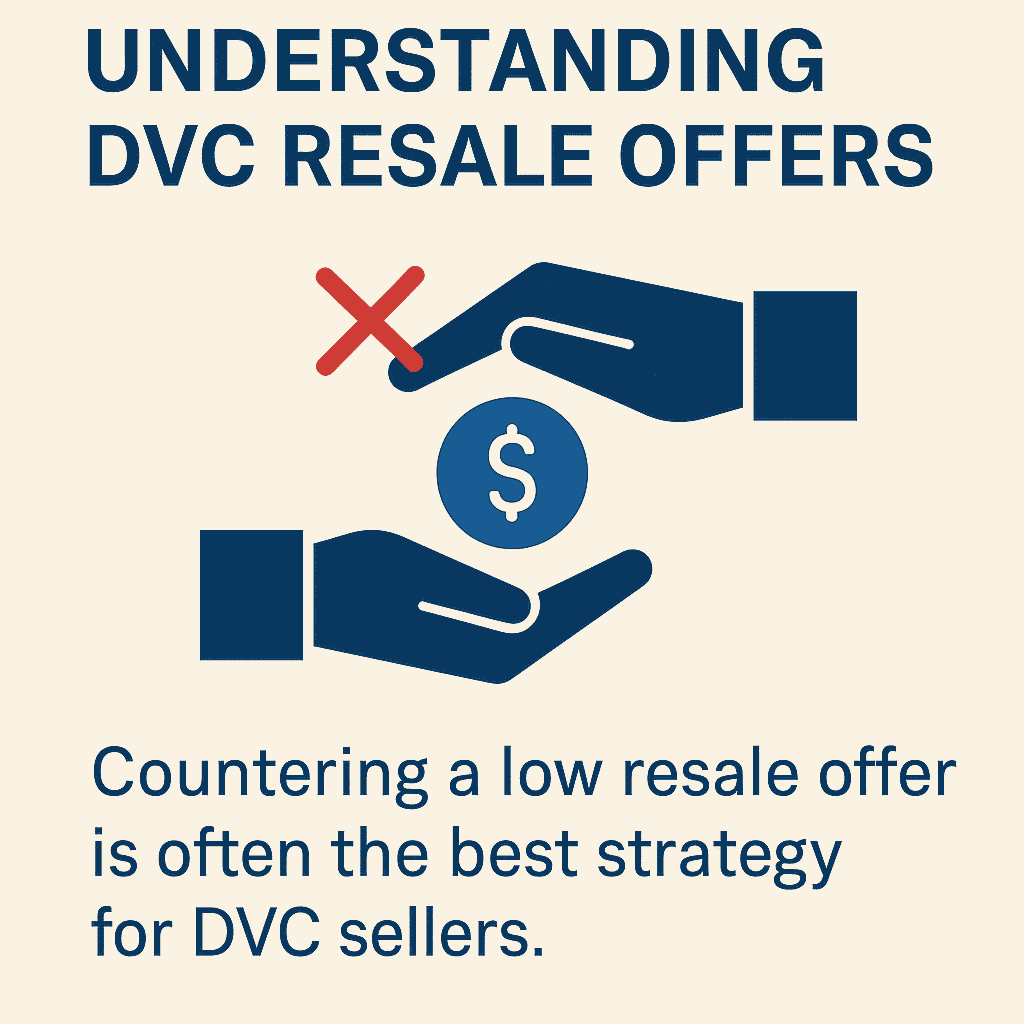
Receiving a low offer on your DVC contract can feel insulting, especially if you have priced it carefully based on current market data. But walking away from a negotiable buyer is rarely the right move. Our rule of thumb at DVC Sales: if an offer comes in within 15 percent of your asking price, it is almost always worth sending a counter. The buyer has signaled genuine interest by submitting something. A counter offer keeps that conversation alive and costs you nothing except a few minutes of your time.
If the offer is more than 20 to 25 percent below your asking price, a counter at your full ask is often the best response. You are not rejecting them outright, but you are signaling clearly that you are not in distress. Some buyers submit low first offers as a test to see how motivated the seller is. A firm counter at your original price communicates that you are confident in your valuation. Many of those buyers come back with something much closer to market rate.
The Psychology of Meeting in the Middle
Negotiation research consistently shows that the party who makes the first concession signals willingness to deal. When you counter at a price between your ask and their offer, you are showing good faith without capitulating. A buyer who offered $120 per point on a $140 ask, for example, would likely settle around $128 to $132 if you counter at $136 or $137. That split-the-difference dynamic is predictable once both sides are engaged.
Where sellers go wrong is countering at exactly their original asking price when the buyer has offered something reasonable. That move can feel like a rejection even though it is technically a counter. If you want to move the deal forward, concede a small amount on your first counter, even $2 or $3 per point. It shows you are serious about selling without dramatically affecting your net proceeds.
Running the Numbers Before You Counter
Before you counter anything, know your net proceeds at each price point. Our commission is 6.9 percent of the sale price. On a 150-point contract at $140 per point, the gross sale is $21,000. After our 6.9 percent commission of $1,449, you net $19,551. At $132 per point, the gross drops to $19,800 and your net after commission is $18,434. That $1,200 difference may or may not matter depending on how long you are willing to wait for a higher offer. We provide current comparable sales data so you can make that decision with real numbers, not guesses.
If you have received an offer and want to talk through your counter strategy, call Mark Webb at (407) 205-1435. We look at what similar contracts have sold for in the past 30 to 60 days and tell you where your contract sits in the current market. Browse active listings and submit your own at dvcsales.com/dvc-resale-listings.



Got Something on Your Mind?
Your email address will not be published. Required fields are marked *